The Vision
What we can show you, and what we have not measured.
Ecored’s stated ambition is “to transform construction across Africa—democratizing access to modern, affordable, and eco-friendly housing for everyone.” This page sets out the environmental half of that: the physical reasons a stabilised laterite wall should carry less embodied carbon than the sandcrete alternative, the conditions under which that advantage narrows, and the parts nobody has measured yet.
Ecored began production in 2026 and has not completed an independently verified life-cycle assessment. So there is no carbon figure on this page, and none anywhere else on this site. What we set out instead is the mechanism — chemistry and haulage distances you can weigh against the published literature on earth construction and against your own site. A mechanism is checkable. A number without its boundary is not; it can only be believed or not believed.
No carbon figure is published anywhere on this site. Not per bag, not per block, not per square metre of wall. A cradle-to-gate assessment is in progress; when it is complete it goes on
the research page with its boundary written above it. If anyone quotes you an Ecored carbon number today, it is not one we measured.
01 — The Binder
Where the clinker argument stops.
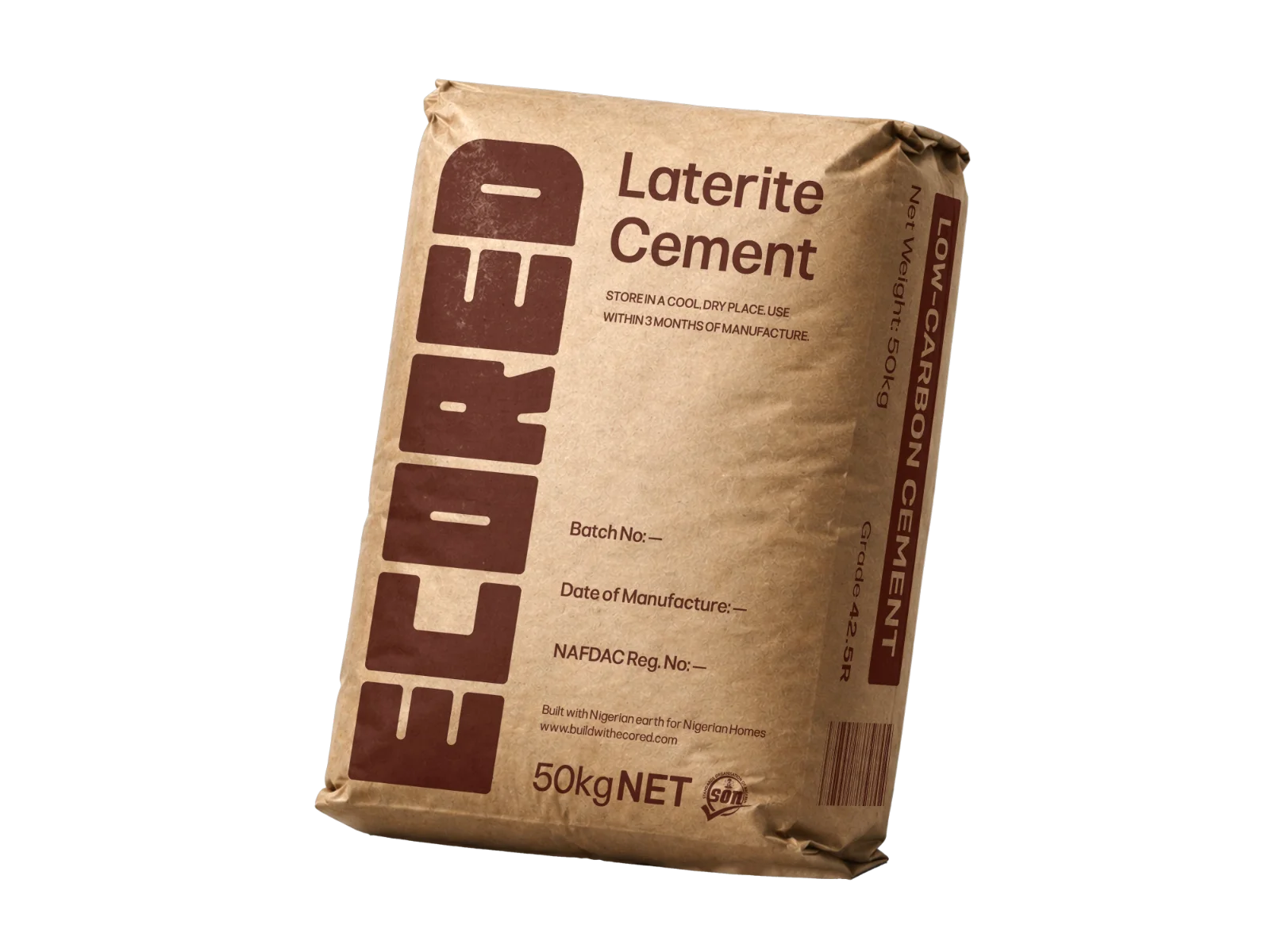
Almost all the carbon in ordinary Portland cement sits in clinker, and our blend replaces part of it with laterite and a pozzolan. That mechanism is set out on the cement specification, and it is established cement chemistry rather than anything Ecored discovered. What belongs on this page is where it stops being an argument and starts needing a measurement.
Why the percentage is missing
We publish the composition and the grade, but not a substitution percentage. On its own it would invite exactly the arithmetic we are refusing to do — multiplying a ratio by a published industry emissions figure and calling the result a measurement of our product. Our blend, our plant and our supply chain are not the industry average.
What the blocks add, and what they do not
A compressed stabilised block is not fired, so against a clay brick the firing energy is simply never spent; against a sandcrete block the comparison turns on the cement fraction and on how far the sand travelled. None of that establishes a quantity. “Less clinker” and “no kiln” are directions, not magnitudes, and the magnitude is what the assessment is for.
02 — The Distance
The heaviest thing on site is the thing worth not moving.
Walling is among the heaviest fractions of a residential build, so the distance it travels weighs on transport emissions more than anything lighter on the same lorry. Sandcrete’s heavy fraction is sharp sand and cement, and both are hauled. Laterite is usually already on or beside the plot. That is the least glamorous environmental advantage the material has and probably the largest.
Processed, not fired
Screening, dosing, pressing, curing. The energy in that sequence is mechanical rather than thermal, which is a far smaller input than holding a kiln at calcination temperature. It is a different kind of load, not a smaller version of the same one.
The same decision shows up twice
Haulage is priced in diesel and road condition, so the tonne-kilometres you do not spend appear as carbon you do not emit and as cost you do not pay. It is the one part of the environmental argument that needs no certificate to check — it is on the delivery note.
The honest qualification: our cement bags do travel. Clinker and pozzolan come from somewhere, the plant is a single line in Wuye, Abuja, and a delivery to Lagos or Enugu is not a short haul. The advantage is strongest for sites near us and near a laterite source; it narrows with distance, and on a distant site with an easy local sand supply it could narrow to nothing. Location is the first thing we ask for on an enquiry, because it moves both the carbon argument and the price.
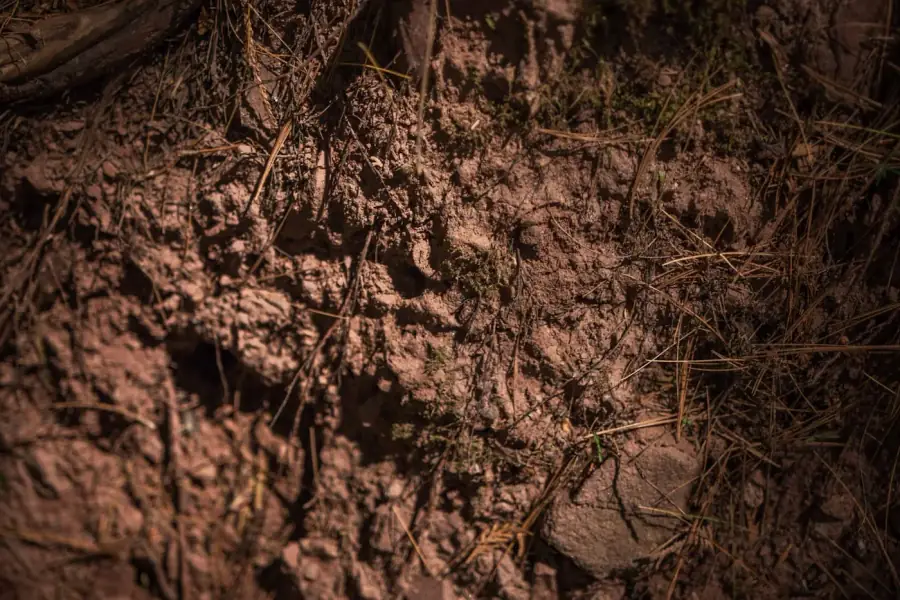
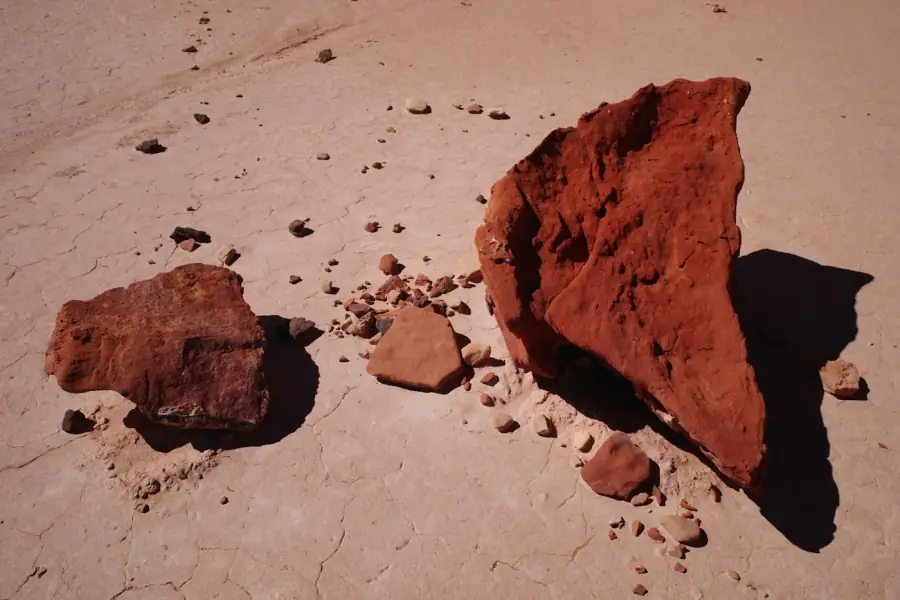
The landscape and site photography on this page is licensed stock showing laterite and earth construction generally. It is indicative of the material and the work — it is not a record of Ecored quarries, plant or sites. We replace it with our own as projects hand over.
03 — The Life of the Building
The carbon that keeps being spent after handover.
Embodied carbon is paid once. Operational energy is paid every month for as long as the building stands, and in this climate a large share of it is cooling. The thermal mass of an earth wall lowers that load — the mechanism is set out on the FAQs — and a cradle-to-gate assessment does not count any of it. Two things follow, and both cut against us.
The first is that we cannot prove it. Ecored has no completed portfolio, so the comparison that would settle the question — an Ecored building and a sandcrete one, same site, same season, both instrumented — does not exist. The mechanism is well documented for earth construction generally; our version of it is not yet measured. When we have measurements they go on the research page with the methodology attached, and if they are less impressive than the literature suggests they still go there.
The second is that thermal mass is not something you bolt onto a bad design. It works with orientation, roof overhang, cross-ventilation and shaded openings, and against large unshaded glazing and a sealed plan. A laterite wall wrapped around a badly oriented glass box saves nobody anything. The material gives a design team something to work with; it does not do the design.
Boundaries
What earth building does not automatically fix.
Four things the material does not do on its own.
There is still cement in it
Stabilisation is what separates our block from a mud block, and the stabiliser contains cement. A lower-clinker blend is not a clinker-free one. Anyone describing compressed stabilised earth as a zero-carbon material is either not counting the stabiliser or not counting the plant.
Extraction is still extraction
Winning laterite disturbs ground. Shallow deposits and modest volumes make the impact smaller than deep quarrying or river dredging, but smaller is not absent, and reinstatement is a discipline somebody has to apply rather than a property the material carries.
A wall that fails early is not a low-carbon wall
Embodied carbon is amortised over the service life of the building, so a wall rebuilt in fifteen years has doubled its own footprint whatever the mix was. That is why the detailing we ask for — raised plinth, generous overhang, drainage away from the base — is not optional. Earth resists weather. It is not waterproof.
The durability programme →
None of it is independently verified yet
Not the carbon, not the cooling. What is independently in place is narrower: the cement is SON certified, and the block testing runs through our research partnership with NBRRI. Certification of a cement grade is not a carbon verification, and a research partnership is not a certification.
If a supplier shows you a carbon percentage for an earth product, the useful question is not whether the number is large. It is what boundary it was measured to, which laboratory issued it, and whether the same boundary was applied to whatever it was compared against. Ask us that too.
The Position
Where the environmental case stands today.
For a specifier who needs it on one screen.
Environmental position, July 2026
| Clinker displacement | Mechanism established in cement chemistry. Our blend is laterite, pozzolan and clinker. Substitution share not published. |
|---|
| Firing | None in block and paver manufacture — they are compressed and cured. The clinker fraction of the cement is kiln-made and bought in. |
|---|
| Haulage | Reduced for the heavy fraction, which is won near site. Cement and plant inputs still travel. Advantage narrows with distance from Abuja. |
|---|
| Thermal performance | High thermal mass, reducing cooling demand. Mechanism documented for earth construction; no Ecored instrumented comparison yet. |
|---|
| Embodied carbon figure | Not published. Cradle-to-gate assessment in progress; no independently verified LCA exists yet. The boundary publishes with the number. |
|---|
| Operational energy evidence | Outstanding. Requires a monitored building against a comparable control. |
|---|
| Durability evidence | Wet–dry cycling under test with NBRRI to ASTM D559. Long-run exposure data does not exist yet. |
|---|
| Extraction | Shallow surface deposits, modest volumes. Site selection and reinstatement are a discipline, not an automatic property. |
|---|
| Cost | Up to 30% lower total build cost against sandcrete — upper bound on a like-for-like walling package, underlying costing not yet published, not independently audited. |
|---|
| Certification held | Cement SON certified. Block testing with NBRRI as research partner. No environmental certification claimed. |
|---|
Every outstanding line above is a piece of work rather than an aspiration. Results publish on
the research page whichever way they land, and this table is updated to match — including the rows that get worse.
The Social Half
Affordability is part of the environmental argument, not a separate one.
Our vision puts “affordable” and “eco-friendly” in the same sentence deliberately. A low-carbon product nobody can buy has no effect on anything.
The cost claim, with its ceiling attached
The cost figure this site carries is an upper bound on a like-for-like walling package, the underlying costing is not yet published, and it has not been independently audited. Your distance from us and your finishing specification move it substantially, and nothing about it comes off the bottom of a quotation.
Where the saving comes from →
A supply chain that stays in the country
Earth won near the site, pressed at a plant in Abuja, laid by a local crew. That describes where the money goes rather than projecting an outcome: it is spent closer to the building than an imported chain spends it, and less exposed to an exchange rate the builder cannot influence. We publish no employment or impact figures — we are one production line, and any number would be a forecast.
Specifying against an environmental target?
Tell us what you have to demonstrate and to whom. We will send the current test position in full, including the parts still blank, so your assessor sees exactly what we see.